
I have to say, I absolutely love reading! Self-help and personal growth books happen to be my primary genre.
I don’t just read; I listen to books too. I am actually listening to one as I write this post. “How does she do it? Listening and writing at the same time?!” Impressive, I know.
Listening makes it so easy to absorb knowledge, whether I’m in the car, going for a walk, or cleaning the house, I can still fit in valuable learning sessions.
For me books either listened to, or read hard copy, are more than just words; they’re a way to grow, heal, and get inspired.
When I first started exploring Stoicism, I struggled a bit with some of the old texts. I’ve read Meditations by Marcus Aurelius and dipped into Senica’s Letters from a Stoic but I felt overwhelmed, like I needed a deep understanding of ancient philosophies to get anything out of it.
But then I found a number of modern books that capture the core principles of Stoicism in a way that’s more relatable and practical in the modern world.
Best Books for the Modern Stoic
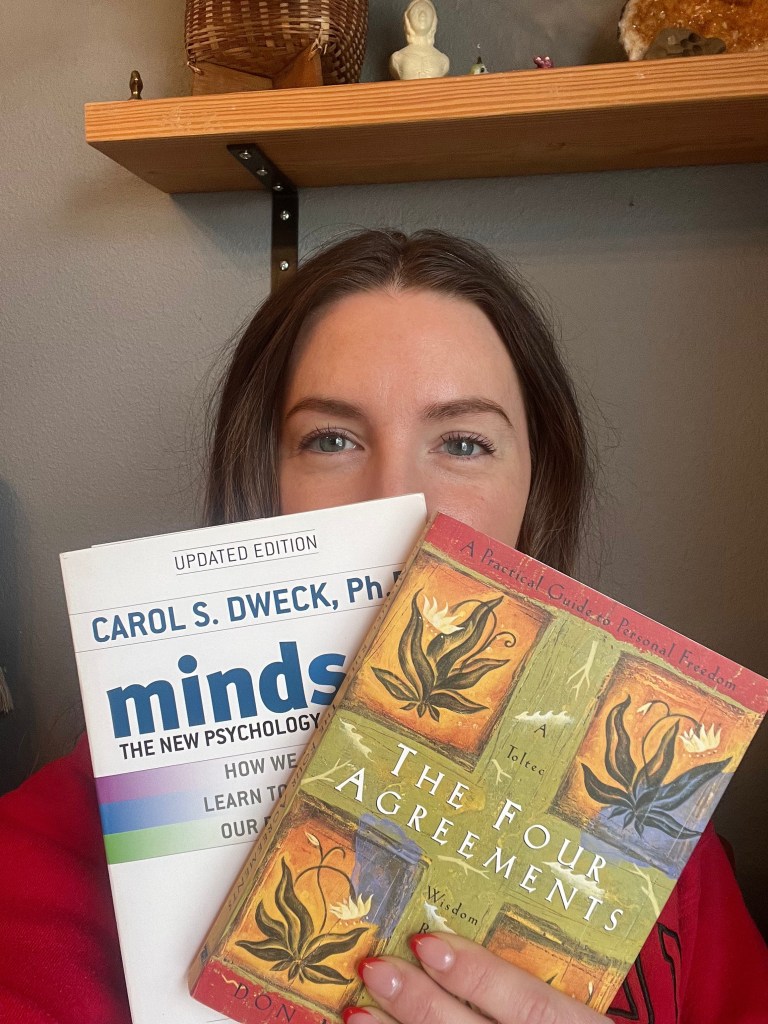
Way before writing on this platform, I’ve been seeking out and soaking up as much content as I could about the topic of Stoicism.
Each of us has a different perspective that helps us navigate the difficulties of life. The lessons I have learned using Stoicism happen to be what resonates most with me.
I wanted to share a few of my most favorite and influential reads. If this is something you enjoy, let me know! I would love to share more!
I’ve read each of these philosophical books thoroughly, two of them, ink on paper, and one as an audiobook. Idk why I feel the need to differentiate. And each, Mindset, The Let Them Theory, and The Four Agreements, has impacted me in different ways.
Books have not only provided me with motivation to live a more fulfilling life, but they also inspire a connection with others.
I was recommended The Four Agreements by a cousin of mine. I read Mindset with a group in college, and my therapist recommended The Let Them Theory.
I now find myself constantly recommending and raving about books to coworkers, friends, and even strangers.
Books have become more than just words on pages, they’re a bridge that connects me to other like-minded individuals.
Each book I’ve read offers new insights, wisdom, and comfort. They spark conversations, inspire change, and create a sense of shared growth.
There’s something truly powerful about passing along a book or sharing a favorite quote because it creates an unspoken bond. It’s like we’re saying, “I’ve been where you are, and this helped me.”
Books help us feel less alone in our struggles and more connected in our desire to become better versions of ourselves.They remind us that growth and transformation are lifelong journeys we’re all on together.
And honestly, there’s nothing quite like the feeling of seeing someone inspired or motivated after sharing a story that touched your heart. That’s the magic of books, they bring us closer, one page at a time.
You don’t need a degree in philosophy to start living the principles these books teach. If you’re like me, someone who’s constantly seeking growth, this list of books might just be your next favorite reading or listening adventure.
1. Mindset by: Carol Dweck
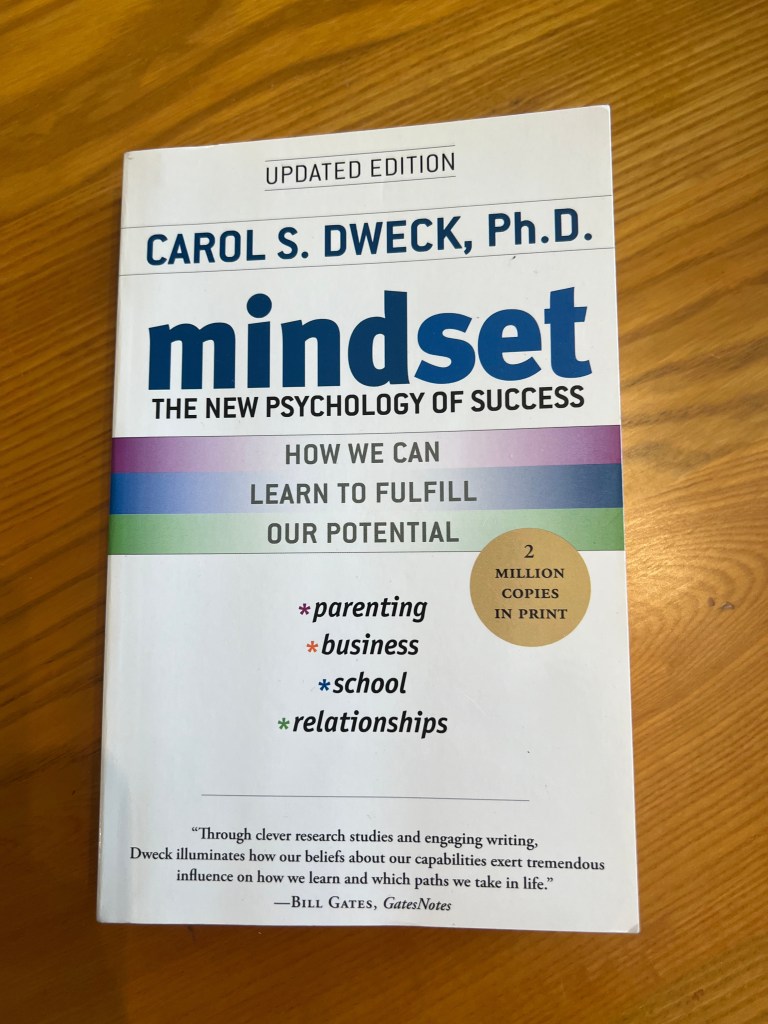
I read Mindset, as a mandatory assignment in my university days. I didn’t know then how much the book would impact my life.
It was one of the first books that really opened my eyes to the power of how our internal dialog shapes our beliefs.
Mindset gave me a new perspective on challenges, it came in handy during my ridiculously demanding program when finishing my degree.
Instead of seeing failures as fixed, I started viewing them as opportunities to learn and improve. That shift in thinking pushed me to keep trying and to push past the demands of a difficult college schedule while also single mom-ing it.
Today, I realize that developing a growth mindset is not just about personal success; it’s about creating a resilient spirit that’s willing to adjust with change and uncertainty.
Honestly, Mindset remains one of the most inspiring and influential books for me because it’s about creating the mental habits that make lifelong growth possible.
I recognize that the way we think about ourselves can totally change the way we live. It’s funny how much power our mindset holds without us even realizing it.
I remember being in college, feeling totally stuck and ready to give up on becoming a dental hygienist.
But when I worked on that first irritating assignment of reading Mindset. (An insight warning us difficulties were to come). I was grateful they had us reflect on what Dweck had written.
From focusing on my limitations to embracing growth, it opened up new ideas. Suddenly, those tough moments didn’t seem so final.
Instead, they became opportunities to learn and improve. Doing hard things creates grit and character. Perseverance is a trait I want to demonstrate to my kids.
That small change in perspective made a huge difference for me, and I started to see how much control I actually had over my progress.
Some of the of key perspectives Mindset taught me:
Fixed Vs. Growth Mindset:
The key discussion of the book is a “fixed mindset” meaning a persons abilities, things like talents and intelligence are fixed traits. Versus “a growth mindset” which is the belief that these qualities are developed with effort and consistency.
By embracing a growth mindset you believe a person can improve and grow no matter your starting point.
View Challenges as Opportunities
With a growth mindset, a choice is made to see difficulties and setbacks as a chance to learn. Dweck encourages her readers to get excited about our challenges instead of fearing them.
When we view obstacles from this perspective, we develop resilience and perseverance which are essential for personal growth.
Effort Over Talent
When learning a new skill those with a fixed mindset often get discouraged when they don’t immediately have a natural talent. Having the mindset that talents can be developed encourages us to realize our potential.
“No matter what your ability is, effort is what ignites that ability and turns it into accomplishment.” pg 41
The Imact of Praise and Feedback
The way we praise both ourselves and others has a huge impact on our outlook. When we praise ability rather than effort it shuts down the idea that things can be challenging and still be worth while.
When we instead recognize effort, it encourages the mindset that growth is possible. Positive feedback should be focused on strategies, perseverance and progress, not innate talent.
2.The Let Them Theory by: Mel Robbins
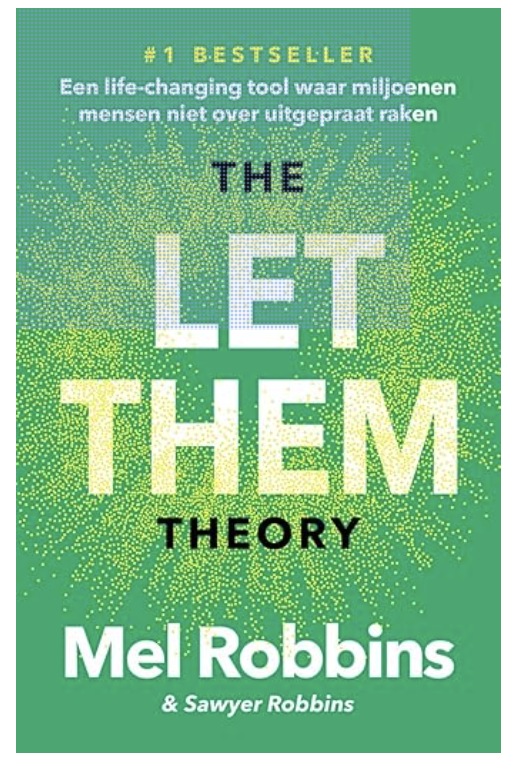
The Let Them Theory by Mel Robbins really emphasizes embracing the power of personal choice.
So many of us get stuck worrying about what others think or feeling guilty for wanting to prioritize our own lives. I mean, it’s easy to fall into that trap.
We often hesitate to make decisions that really benefit us because we fear upsetting others. But Mel flips that idea on its head.
She encourages letting go of the need for approval and to stop seeking external validation. Her main message is simple: You cannot control others.
How they react to your choices, what they are feeling, or the actions they choose, but you can control yourself. “Let them, and let me.” Stoic genius!
As you read through Mel’s insights, you’ll find practical steps to regain control of your life. She emphasizes the importance of taking ownership of your decisions and to let go of controlling others.
By learning to embrace the discomfort that comes with saying no or pursuing what feels right for you, you create the space for authenticity and happiness. Let’s be honest, this can be tough.
Change doesn’t come easy, and the fear of judgment or rejection often creeps in. But here’s the thing, when you learn to “let them” have their feelings about your choices, it frees you to live your life more fully.
One of the things I love about this book is how relatable Mel Robbins approach is. Her writing feels like a conversation with a friend who she genuinely wants to succeed.
I listened to her book on Audible, it was just like her podcast. If you haven’t listened, I would highly recommend The Mel Robbins Podcast! It feels so personal and unscripted. She shares her struggles, and real-world strategies that make her message stick.
If you’re ready to take charge of your life and stop letting others dictate your decisions, The Let Them Theory is a must-read. You’ll find the courage and confidence to pursue your dreams unapologetically.
As you read through Mel’s insights, you’ll find practical steps to regain control of your life.
Here are some of my biggest takeaways from the book:
Set Your Own Boundaries:
Setting boundaries is a must for protecting your time and energy. Mel emphasizes that saying no is not a sign of weakness but a necessity to maintain your energy.
By establishing what you will and won’t tolerate, you create a space where you can focus on what truly matters to you.
Own Your Decisions:
Owning your choices is liberating. The Let Them Theory encourages us as readers to take action based on what they truly want, rather than seeking outside approval.
When you embrace this conccept, you not only empower yourself but also encourage others to respect your decisions, leading to a more authentic life.
Embrace Discomfort:
Growth is often found outside our comfort zones. Not everyone will see things the way you do, let them. We are all on our own journey here. Discomfort may feel scary, but it’s an essential part of our growth.
By leaning into those uncomfortable feelings we stand in our power. Let what isn’t meant for you pass to make space for what is meant for you.
Surround Yourself with Support:
Find your pack. (I just watched Zootopia 2 with my kids, don’t mind the movie reference). The people you choose to spend time with influence your mindset.
Mel advocates for surrounding yourself with those who uplift and support you. Find relationships that encourage you and give you the confidence to pursue your dreams.
You Are the Love of Your Life:
At the end of the day, the person that is going to be there is you. Self-love is the foundation to living your most authentic life. Knowing your worth independent of others opinions leads to healthier choices.
When you learn to love and accept yourself, you’re empowered to do what makes you happy without fear of rejection or judgement.
3. The Four Agreements: A Practical Guide to Personal Freedom by: Don Miguel Ruiz
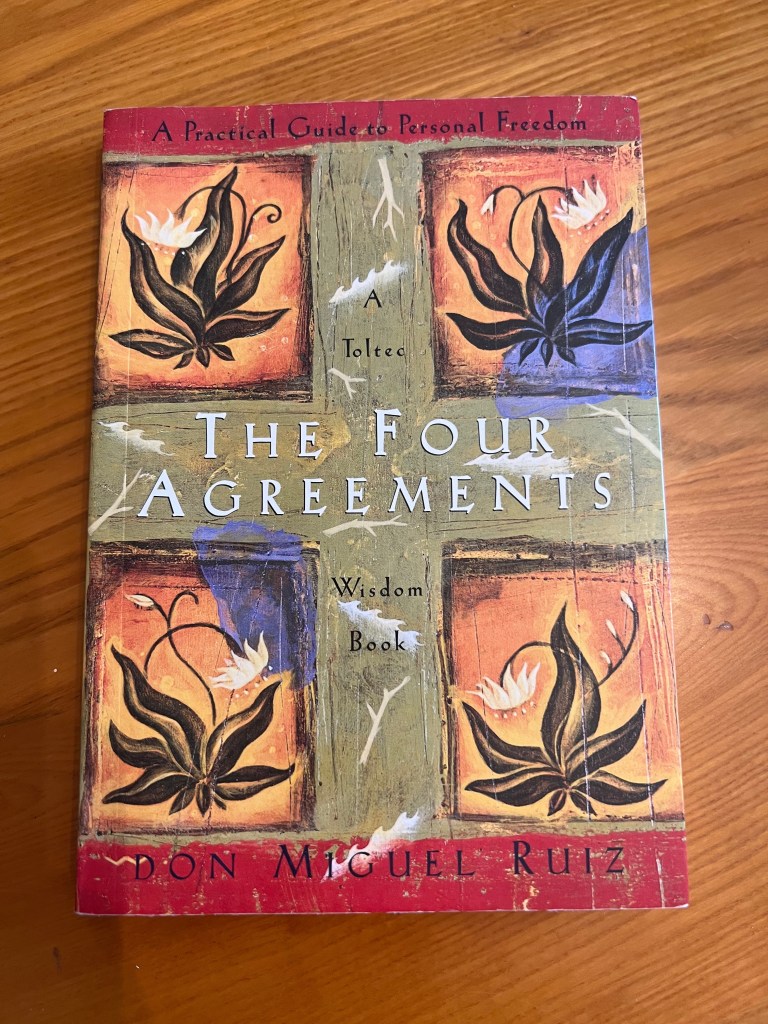
When I first picked up The Four Agreements, I was genuinely curious about how it might influence my perspective on life.
A cousin of mine had recommended it, sharing how much it had transformed her world view. Plus I kept seeing it pop up on social media, often in people’s favorites lists. It felt like a sign that I should see what it was all about.
Don Miguel Ruiz gives us a guide to the wisdom of The Toltec, an ancient group of artists and scientists in Mexico and known as the “women and men of knowledge.”
Through these four powerfully simple principles we can transform the way we think and interact with the world. If you are ready to start your self-help journey, this short read is a great place to start.
His agreements aren’t just guidelines, they’re more like a set of helpful tools for living your life with ease, all while keeping you grounded in that stoic mindset.
The Four Agreements:
“Attention is the ability we have to discriminate and focus only on that which we want to perceive.” – Don Miguel Ruiz.
A classically Stoic perspective.
- Be Impeccable with Your Word
Our words hold power! What we say matters. The first agreement is in Don Miguel’s perspective the most important, and in my perspective, the most difficult to follow.
Not only can your words manifest and create the life of your dreams, but they can also have the power to hurt and manipulate the lives of yourself and others.
This reflects the Stoic belief that how we communicate and the energy we put out into the world is hugely important.
If you’re curious about how to harness the power of your words while staying grounded in Stoic principles, check out my article on the connection between manifestation and Stoicism.
“The word is the most powerful tool you have as a human; it is the tool of magic.” “Your word is pure magic, and misuse of your word is black magic.” – Don Miguel Ruiz.
By embracing the power of our words and using them wisely, we can not just manifest our desires but also uplift those around us.
Let’s commit to speaking with intention and kindness, recognizing that every word is an opportunity to create a positive impact in our lives and the lives of others.
- Don’t Take Anything Personally
Game freaking changer!!!! This agreement taught me that other people’s actions and opinions are a reflection of their own realities, not a statement about my character.
When someone has a negative reaction or criticizes something I am doing or saying, it’s easy to internalize, second guess, or even change my opinion.
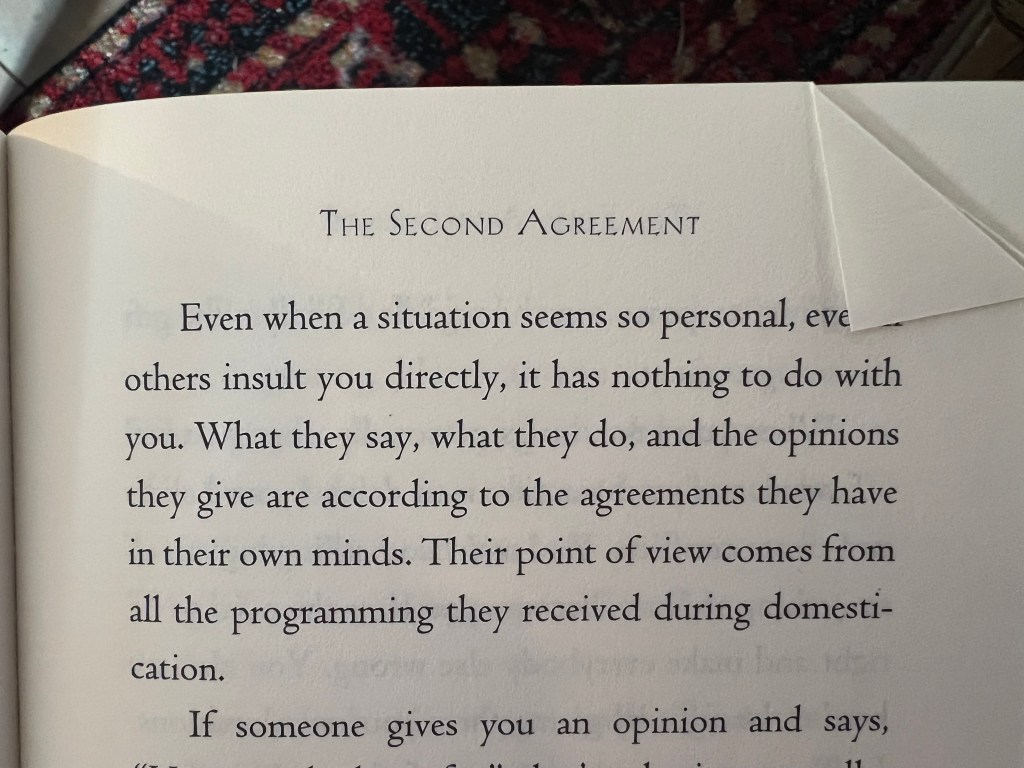
For instance, there have been a handful of times when I’ve received harsh feedback at work from employers and/or patients.
By not taking things personally, I can reflect on others responses, and see that they often stem from their own internal dialog.
Their internal reality might be dealing with insecurities, stresses, or unresolved trauma that I know nothing about, (and frankly, have nothing to do with me).
In the past, experiencing others negativity would cause me to ruminate, and over-think. Now seeing things from this perspective, my peace and self-esteem remain shielded.
- Don’t Make Assumptions
The third agreement presses us to Not Make Assumptions. This might sound straightforward… but holy hell! how often do we misread or jump to conclusions?
My therapist says never to text overly emotional concerns. “Someone will always misinterpret something”.
I’ve been guilty of jumping to conclusions more times than I’d like to share. My ADD often fills in the blanks without having all the information, sometimes convincing me that I know what others are thinking or feeling.
Boy has this lead to misunderstandings. That early judgement quickly snowballs into unnecessary hurt and conflict.
Ruiz challenges us to ask questions and communicate clearly before making assumptions. It’s an empowering reminder that taking a moment to seek clarity can prevent a lot of distress.
For instance, I had a moment recently where my partner seemed to be judging me. My mind all at once went to an assumption of judgement AND choosing to think the best of him.
I started by feeling anxious and defensive. But instead of spiraling, I decided to approach him directly.
I asked for perspective, stating that I felt judged and wanted some clarification on what he meant in his statement.
As it turned out, he was just genuinely curious about what I was talking about and quickly reassured me that no judgements had been made. Instant relief!
A simple shift, reaching out instead of guessing, can significantly lighten the emotional load we carry.
Choosing to communicate openly, and asking questions before making our own judgements creates a space for understanding and connection. It allows relationships to deepen rather than deteriorate over misunderstandings.
It’s all about forming genuine connections and reducing the mental clutter that comes from misinterpretation.
So the next time you feel a sense of uncertainty about someone’s actions or words, remember to pause, ask questions, and seek understanding.
You might just find that what you assumed was completely off base.
- Always Do Your Best
Finally, the last of the four agreements encourages us to Always Do Your Best. This agreement is about grace.
Having the understanding that your best isn’t a rigid standard; it varies depending on the circumstances.
Some days, I feel energized and ready to tackle the day head-on, while other days I find myself feeling drained or less motivated.
And that’s perfectly okay! What matters is that we show up and put in the effort, whatever that looks like on any given day.
In the past, I often equated “doing my best” with achieving a level of perfection.
I thought I always had to be doing. Keeping a perfect home, making sure my children were always busy, eating right, working, working, working.
This pressure led to heavy stress and a feeling of inadequacy. But when I shifted my focus from perfection to progress, everything changed.
It’s liberating to realize that my best, on a particularly exhausting day, might simply be showing myself grace.
Reminding myself that taking care of my mental health might look like a nap, not getting the dishes done, or yes, doom scrolling.
This mindset has encouraged me to be kinder to myself. It allows me to see that growth isn’t linear; it’s full of ups and downs.
Knowing that I’m doing my best helps me stay motivated even when results aren’t immediately visible.
Ruiz reminds us that doing our best is not just about the outcome; it’s also about the effort itself. It’s about building the habit of persistence, developing discipline, and being proud of the commitment you show to your path.
In essence, this agreement teaches us to focus on the journey rather than chasing the destination. And as Stoics would remind us, it’s our actions and intentions that shape our character and, ultimately, our lives.

Final Thoughts
In wrapping up my thoughts on these books, I can honestly say they’ve each had a profound impact on my journey of personal growth.
Each one has taught me valuable lessons that I carry with me. From Mindset, I learned the power of believing in my ability to grow and change.
It shifted my perspective from feeling defeated by failure to viewing it as a stepping stone.
With The Let Them Theory, I found the courage to prioritize my own happiness and to take responsibility for my choices.
It reminded me that my worth and perspective matters. Others are living their own lives, and how they show up in mine cannot be forced or changed by me.
I can’t please everyone and trying to creates disingenuous relationships.
This shift has helped me approach my life with more confidence and authenticity.
Then there’s The Four Agreements, which influences the way I communicate and interact with others.
The focus on being impeccable with my word and not taking things personally has improved my relationships and brought more peace into my life.
I strive to live by these agreements each day, and recognize that they help me align with my true values.
Together, these three books have opened my eyes to the possibilities of living a life with more purpose and intention.
If you’re on a journey of self-discovery and growth, I cannot recommend these titles enough!
They’ve given me tools to not only manifest my dreams but also to appreciate the process along the way.
Have you read any of these titles? I’d love to hear your thoughts in the comments!
With Stoic grace, and manifesting magic, your friend and fellow Student of Stoicism, Mimi.

 Student of Stoicism
Leave a comment